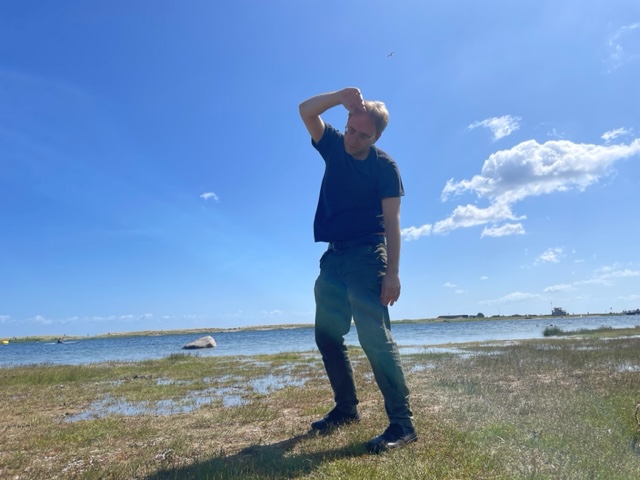
What are nervous system states?
According to Stephen Porges’ Polyvagal Theory, a distinction is made between the state of social engagement—where you feel calm, safe, and connected—and states of activation (fight or flight) and deactivation/relaxation, which in the extreme leads to freezing.
Every state has its function as a survival reaction, but also in everyday life by allowing more activation when energy is needed or the nervous system sends an impulse for relaxation. It becomes problematic when, after a trauma, this energy is not processed and therefore remains permanently activated.
The two directions in which we function
Mostly, we look at ourselves in a so-called “top-down” manner—our thoughts influence our feelings and our body. This is true to begin with, and at the same time, the opposite is also true, called “bottom-up.” Our body influences our feelings and our thoughts. Some approaches focus more on top-down, especially when it comes to understanding what happened or understanding one’s own patterns, etc. Body-oriented approaches use both ways: top-down and bottom-up.
How my nervous system influences my thoughts and feelings
If my nervous system is stuck in flight, I will have corresponding thoughts; there might be a basic feeling that it is never safe, that one must constantly move. If I am in fight mode, it is about alliances, who is a friend and who is an enemy, good and evil, everyone is against me—there are dozens of variations of this.
Typical freeze thoughts are: it will never change, I could rest forever, thoughts of helplessness. Understanding the nervous system means for me, being able to observe more and more from which state my thoughts and feelings arise, and in the next step, perhaps not to see them as absolute truth. Instead, I can then first look at what I need in order to get into a different, regulated state.
Curiosity is a good sign that I have landed back in the social engagement part of the nervous system.
Curious?
If you would like to learn more about my work, feel free to book a free 15-minute discovery call. This will allow us to get to know each other and figure out how I can support you.
The next step would then be an initial 90-minute session for an anamnesis, which will also give you a first impression of my work. We will also look at which of the methods I have learned would best suit your needs.
Guiding the nervous system into new paths and possibilities takes time. We will individually determine the framework for the sessions, including the rhythm and estimated duration.
Do you have any questions? Then book your free discovery call here: